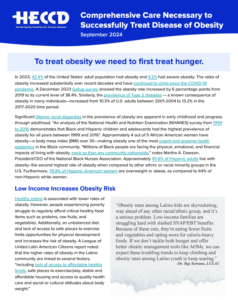
As the obesity epidemic surged to unprecedented levels this year — disproportionately affecting communities of color and continuing our public health crisis — a group of prominent civil rights leaders, healthcare professionals, and public health advocates came together to launch a historic effort called the Health Equity Coalition for Chronic Disease, to advance health equity and eliminate barriers to care and treatment for obesity and other chronic diseases. Leaders of the coalition have assembled this report to collectively call for urgent action in 2023, to prevent a wave of consequences from continuing to ripple across communities of color.
TOPLINE: Current obesity policy is woefully outdated and failing communities of color — in 2023, five key policy priorities must anchor the foundation of improving the health and well-being of people of color, eliminate policies that preserve the roots of poverty and systemic racism, and open new pathways to accessing obesity treatment and care.
Obesity’s Dangerous Milestone In 2022
The obesity epidemic has become one of the most pressing public health crises facing the U.S., affecting nearly 100 million Americans [CDC] — including 43% of adults over the age of 60 [CDC] — and plunging entire communities into dangerous and costly battles with this complex chronic disease. The disease of obesity is linked to more than 200 serious health conditions [CDC] — including heart disease, diabetes, high blood pressure, and strokes — and disproportionately affects Black and Brown communities at rates that are devastating.
What’s worse, the obesity crisis is showing no signs of slowing. This year, the obesity epidemic hit a dangerous milestone as the Centers for Disease Control and Prevention (CDC) announced the number of states with high rates of adult obesity more than doubled [CDC] since 2018 — with 35% of residents in nearly 20 states now living with adult obesity.
The CDC’s data is shocking for two reasons. First, projecting our future: with obesity trendlines seemingly racing toward engulfing more and more states, it’s only a matter of time before these statistics start doubling again. As these trendlines barrel toward a colossal public health emergency, the CDC’s data prompts the questions: How bad will it get before healthcare leaders and policymakers take action to stem the tide? And is there a threshold we’ll eventually cross where there’s no turning back? Second, learning from the past: what we have been doing is not working. The CDC’s new obesity data comes more than 20 years after it declared obesity an “epidemic” in 1999 [CDC]. Nearly a quarter-century later, this public health problem persists, and is growing exponentially worse.
This is a health crisis that will spur irreversible consequences if urgent action is not taken by policymakers and healthcare leaders. It’s an emergency that requires a collective national response — but it’s also an emergency that’s unfairly and unforgivingly being felt most by communities of color.
Urgent & Growing Threat to Communities of Color
Despite decades of research and advocacy, the epidemic continues growing without restraint, as more than 42 percent of Americans are living with obesity. The chronic disease is wreaking greatest havoc on communities of color — who are affected at much higher rates than white Americans, and who are at greater risk of a plethora of comorbid health issues. People of color and historically disadvantaged communities are increasingly shouldering the burden of obesity in ways that other communities aren’t:
- Currently, 60% of Black women [AMA], nearly half of all Black Americans, and 44.8% of Latino Americans [CDC] live with the disease of obesity — as a result, these groups are at higher risk for heart disease, stroke, and cancer [CDC].
- This puts communities of color at a greater risk for other serious chronic diseases — Black Americans are 77% more likely [AJMC] to be diagnosed with type II diabetes and are likely to have high blood pressure more than any other population group [CDC].
- Diabetes increases the likelihood for heart disease, stroke, kidney damage, amputation, blindness, and nerve damage; and high blood pressure, which is more common among Black Americans than any other racial or ethnic group [CDC], can lead to heart disease, heart attack, stroke, and pulmonary embolism.
- American Indians and Alaska Natives are also 50% more likely than white Americans to live with obesity [HHS], and those numbers are growing across the board [TFAH].
- For Asian Americans, new studies reveal serious health disparities among subgroups [AJPH] that were previously masked by aggregation.
Despite being a preventable and treatable disease, rates of obesity continue growing at a breakneck pace across communities of color, causing destructive health consequences that are crippling the finances, futures, and physical health of millions of people of color — who statistically experience worse health outcomes, higher rates of degraded mental health, and decreased economic viability associated with obesity.
Systemic racism, unequal access to health care, and bias in the health care system are among the many drivers behind higher rates of obesity among people of color. But the nation’s outdated Medicare policies are also playing an integral role in perpetuating the status quo. While an “all of government” approach is needed to combat the obesity epidemic, addressing the discriminatory policies that currently underpin Medicare — one of the nation’s largest health care coverage programs — is critical to remove existing barriers that prevent millions from accessing the treatment they need to effectively and successfully fight this chronic disease.
Discriminatory Medicare Policy Perpetuates Inequities
Widespread stigma and outdated perceptions of obesity have played dangerously into the lack of effective obesity policy in the United States. Misconceptions that obesity is an issue stemming from “personal behavior” and “lack of willpower” have too often prevailed over science in determining the nation’s policy response.
These dangerous perceptions of obesity continue to underpin policy, perhaps nowhere more evident than in the outdated and discriminatory Medicare laws that put comprehensive care out of reach for people living with obesity. By excluding FDA-approved anti-obesity medications (AOMs) from Medicare Part D coverage, Medicare offers limited, inadequate, and largely insufficient treatment options to the millions of people living with obesity — further perpetuating health inequities that disproportionately affect communities of color.
When Congress passed Medicare Part D in 2003, obesity was not recognized as a disease nor had it reached the pandemic levels we see today. The science behind anti-obesity medications was in its infancy. Since then, a lot has changed — not only does the American Medical Association (AMA) recognize obesity as a preventable and treatable chronic disease, but the broader scientific research community has developed a far deeper understanding of the drivers of obesity and how to treat it. There have been major advancements in the diagnosis, prevention, and treatment of obesity — but obesity care coverage and related policies have not evolved.
Medicare Part D remains unchanged in its lack of comprehensive obesity care coverage. For the millions of people reliant on Medicare Part D — many of whom are members of Black and Latino communities — access to lifesaving medical treatment is out of reach. In effect, Medicare’s lack of obesity care coverage policies are discriminatory toward some of the most at-risk and marginalized communities, continuing to perpetuate grave inequities in health outcomes.
Medicare Becoming an Outlier in Health Coverage
A number of national and state public insurance programs are increasingly updating policies to align with medical practice guidelines. Recognizing obesity as a treatable chronic disease, programs like TRICARE, the Federal Employees Health Benefits Program, and some Medicaid programs — like those in Maryland, Pennsylvania, and Michigan — are ushering in AOM coverage policies. Similarly, State Employee Health Benefit plans in 27 states have updated coverage policies to ensure access to AOMs, including in Iowa, Georgia, Florida, Ohio, Colorado, Rhode Island, Idaho, and North Dakota — all of which modernized coverage policies this year.
These advances in coverage acknowledge the importance of modernizing coverage programs to meet the needs of today. As every health system participant in the country examines its role in driving health equity, it’s imperative that Medicare acknowledge and address its own outdated policies that continue to perpetuate grave inequities in health care coverage.
2022 Timeline: A Year of Momentum
- February 2022 — The U.S. Office of Personnel Management announces that the Federal Employees Health Benefits program will begin covering anti-obesity medications in 2023. [OPM]
- March 2022 — A new study indicates 1 billion people across the globe will have obesity by 2030 — including 64 million women and 61 million men in the U.S. [World Obesity Atlas]
- April 2022 — Civil rights and health equity leaders launch the Health Equity Coalition for Chronic Disease (HECCD) to eliminate barriers to healthcare facing communities of color — focusing its first-year initiative on obesity. [HECCD] In an op-ed in The Hill, HECCD co-chairs call for urgent action on obesity: “So long as historically marginalized Americans are suffering, we will not be able to effectively rebuild and heal our nation.” [The Hill] The Health Equity Accountability Act of 2022 is introduced in the U.S. House, aimed at eliminating racial and ethnic health inequities and supported by more than 300 advocacy groups. [HECCD] In a USA Today op-ed, Rev. Al Sharpton and clergy leaders from ChooseHealthyLife urge action to address obesity amongst Black Americans: “The data is clear. Why then, is obesity care not fully covered under our federal health programs? For Black Americans – exclusions like these can mean the difference between life or death.” [USA Today]
- May 2022 — A new study indicates the proportion of children and adolescents from low-income families with overweight or obesity increased markedly during the first six months of the COVID-19 pandemic. [source]
- June 2022 — In an op-ed in Univision, former U.S. Surgeon General Dr. Antonia Novello argues: “The seriousness of the obesity epidemic and the overall Hispanic health that results from obesity’s comorbid diseases, like type 2 diabetes, cardiovascular disease, and stroke, cannot be ignored. … It’s extremely important that Medicare and private insurers take every step to ensure the full coverage continuum of care.” [Univision]
- July 2022 — A new report indicates rising obesity rates in the United States are slowing life expectancy gains, accelerating aging and widening racial health disparities. [PRB]
- August 2022 — Ahead of the White House Conference on Hunger, Nutrition, and Health, HECCD brings together leaders across the health equity and civil rights spaces for a national listening session, generating a series of policy recommendations for the Biden administration to address obesity and advance health equity. [HECCD] In an op-ed in the New York Daily News, Rev. Carl L. Washington Jr. of Empire Baptist Missionary Convention calls on Congress and the Biden administration to address lack of obesity treatment coverage, arguing “Obesity is threatening our prosperity.” [NY Daily News] National Black clergy and medical leaders meet with HHS Sec. Xavier Becerra to urge action on addressing health equity and improving health outcomes for communities of color, highlighting obesity as a top issue requiring urgent action. [HECCD] In an op-ed in MedPage Today, former U.S. Surgeon General Dr. David Satcher argues that “the burden of obesity is not carried equally,” urging lawmakers to “remove the impediments to health equity through access, and promote a path that eliminates the obesity epidemic persisting in communities of color across our nation.” [MedPage Today]
- September 2022 — The White House hosts a historic Conference on Hunger, Nutrition, and Health, and releases a national strategy that includes important first steps toward addressing obesity through prevention measures. [HECCD] The CDC releases new bombshell data that indicates the number of states with high rates of adult obesity more than doubled since 2018 — with 35% of residents in nearly 20 states now living with adult obesity. [CDC]
- October 2022 — A congressional Tri-Caucus led letter — including 50 Members of Congress — urges CMS to update Medicare coverage policies to include access to anti-obesity medications. [HECCD] The American Gastroenterology Association announces new policy strongly recommending AOMs for treating obesity. [HECCD] The Institute for Clinical and Economic Review calls for Medicare and Medicaid coverage of AOMs in a series of new policy recommendations. [HECCD]
- November 2022 — The American Medical Association releases a new comprehensive strategy to address obesity and reduce barriers to care, representing an important step forward for improving health equity. [HECCD]
- December 2022 — The American Medical Women’s Association releases a white paper on women and the obesity epidemic, calling for better treatment access for women. [HECCD]
Five Priorities: Urgent Action Needed in 2023
The leaders of the Health Equity Coalition for Chronic Disease are pushing for Congress and the Biden administration to closely examine and take swift action on ineffective and outdated obesity policies to remove barriers to treatment and care for communities of color. The coalition is urging Congress and the administration to prioritize a series of urgent actions in 2023 including:
- Medicare must provide access to the full continuum of obesity treatment and care, including anti-obesity medications. Currently numerous barriers exist for patients to access Food & Drug Administration (FDA) approved anti-obesity medications (AOMs). Only 2% of those eligible for anti-obesity drugs are prescribed these drugs. This lack of access hits hardest on communities of color that are contending with the highest rates of obesity in the US. To strengthen efforts toward health equity, we must eliminate barriers to prescribing anti-obesity medications, modernize coverage policies for AOMs, and improve physician training and knowledge of AOM availability and efficacy. Medicare and Medicaid must provide coverage for these medications as their fellow federal health insurance coverage agencies have. Current Medicare Part D policies are outdated and do not cover anti-obesity medications. The Administration should either change this policy or call on Congress to act swiftly to change the law.
- Require federal policy to reinforce the full continuum of care through workforce training and federal program coverage policies. Providers need to recognize heterogeneity among patients, especially the diversity of people of color, through comprehensive assessments that tailor obesity treatments to the individual. Providers should be trained to appreciate the crudeness of the Body Mass Index (BMI) as a measurement for predicting the obesity-related risk of type II diabetes and cardiovascular disease, as the tool was not built with the uniqueness of communities of color in mind. Providers must help patients access the full continuum of care, including the following evidence-based treatments: intensive lifestyle interventions, including counseling to promote healthy eating and physical activity, access to anti-obesity medications, bariatric and metabolic surgical procedures when indicated, and the appropriate management of other related health conditions.
- Prioritize efforts at the CDC and other federal agencies to end the use of language that reinforces negative stereotypes and perpetuates stigma around obesity. End the widespread stigmatization of people with obesity. Medical professionals should be trained to end stigmatization. Currently, people with obesity often avoid medical care because of their treatment by medical professionals, this is especially true in communities of color. When they seek help, their medical issues can be ignored because of weight bias, leading to inadequate treatment. Our language must also change. There are no obese people; there are people living with obesity. The use of the term morbid obesity should be eliminated. It is a fatalistic term that ignores that obesity is a treatable disease. CDC (Centers for Disease Control) and other federal agencies should do their part in encouraging a paradigm shift.
- Require Medicare to provide access to behavioral and nutritional counseling without the requirement of co-morbidities. Behavioral and nutritional counseling are critical components of care for people living with obesity. Currently, if you have obesity, you must also have diabetes to work with a dietitian covered by Medicare.
- Through Medicare and Medicaid, expand the federal government’s use of innovative programs that increase access to fruits and vegetables, and initiatives that educate families and individuals on how to incorporate these foods into a healthy diet. The federal government must go beyond its traditional nutrition assistance programs and expand access to innovative programs through Medicaid and Medicare to increase access to fruits and vegetables and training on incorporating these foods into an individual or family diet.
Legislative Vehicles
The coalition also supports legislative vehicles to help stem the spread of the obesity epidemic and its impact on communities of color, including:
The Treat and Reduce Obesity Act (S.596 — Treat and Reduce Obesity Act of 2021). TROA would expand Medicare coverage to include screening and treatment of obesity from a diverse range of healthcare providers who specialize in obesity care. The bill would also include coverage of FDA-approved medications for chronic weight management.
The Health Equity and Accountability Act (H.R.7585 — Health Equity and Accountability Act of 2022). “This legislation would address social determinants of health, improve access for underserved communities, address maternal health and mental health crises, gun violence and more.” — Rep. Robin Kelly (D-IL). It includes the Treat and Reduce Obesity Act, H.R. 1577.
The Health Equity Coalition for Chronic Disease
The Health Equity Coalition for Chronic Disease (HECCD) believes that all people deserve the best possible health care. Continuing to allow outdated coverage policies to restrict access for communities dependent on public programs is counter to the principles of health equity. The mission of the Health Equity Coalition for Chronic Disease is to ensure that community experts, policymakers, providers, and other stakeholders work together to eliminate barriers to healthcare for communities of color, especially as related to access to care and treatment for obesity and other chronic diseases.
More information about the coalition can be found at HealthEquityAction.org.