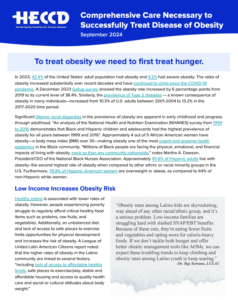

The disease of obesity is literally a life or death issue for millions of Americans. “Long stigmatized as a reversible consequence of personal choices, obesity has complex genetic, physiologic, socioeconomic, and environmental contributors.”[1] Obesity is a chronic disease that impacts 42 percent of the US population in both red states and blue states.[2]
With this paper, the Health Equity Coalition for Chronic Disease (HECCD) is highlighting the impact and prevalence of the disease of obesity across America, including among Black and Hispanic Americans, people living in rural communities, and those living in poverty. Different aspects of a person’s identity, such as race, class, and gender, can create overlapping forms of discrimination or disadvantage, which is particularly evident in obesity trends.
Access to healthcare, as well as healthy and nutrient-dense foods, is impacted by systemic racism and social constructs such as race, ethnicity, and where people live.[3] Marginalized racial and ethnic groups are more likely to be uninsured than white people.[4] Those without insurance or underinsured individuals are less likely to receive preventive care.
Recognizing “the historic failure to invest sufficiently, justly, and equally in underserved communities,[5] as well as individuals from those communities”[6] President Biden signed an Executive Order on his first day in office that requires his Administration to “pursue a comprehensive approach to advancing equity[7] for all, including people of color and others who have been historically underserved, marginalized, and adversely affected by persistent poverty and inequality.”[8] We believe that a comprehensive approach to combating and preventing obesity flows from this directive. The clock is ticking, and now is the time to change policies that are preventing access to comprehensive care and “revolutionary”[9] treatments for individuals suffering from the disease of obesity.[10]
Obesity Is a Leading Cause of Preventable Deaths
Not only is obesity complex, but it is an epidemic we cannot ignore. Obesity leads to a myriad of additional health problems. Nine of the top 10 leading causes of death in America have obesity and excess body weight as a risk factor.[11] Obesity is second only to smoking as the most preventable cause of death in the US.[12] Anti-tobacco and anti-smoking campaigns have proven effective in reducing the number of tobacco-related deaths while obesity rates continue to climb. It won’t be long before obesity overtakes smoking as the most preventable cause of death.[13]
Obesity Leads to Significant Financial Strain on the Individual
U.S. law protects against workplace discrimination on the basis of race, religion, age, and gender; however, discrimination on the basis of weight is legal. Not only is there no legal barrier to weight-based discrimination, but this kind of discrimination is quite real,[16] and has a significant financial impact on people with obesity over the course of their lives. People living with obesity earn less and are also less likely to be hired — this financial impact is most stark for women living with the disease.[17]
In addition to this wage penalty, the individual cost of managing the disease of obesity is high. A significant barrier to care is the out-of-pocket expenses, such as copays and high-cost deductibles associated with treatment for the underlying disease of obesity itself, as well as the diseases and conditions it causes, such as diabetes, hypertension, and musculoskeletal pain and dysfunction. Out-of-pocket health care costs for patients diagnosed with obesity rose by 37% over the last decade — and that’s just for those with private insurance.[18]
A Journal of Managed Care + Specialty Pharmacy 2021 report found that the “annual medical care expenditures of adults with obesity ($5,010) were double that of people with normal weight ($2,504).”[19] Furthermore, annual medical care costs at the individual level increased with each class of obesity: a 68.4% increase for class 1 obesity, a 120.0% increase for class 2 obesity, and a 233.6% increase for class 3 obesity.[20]
Moreover, cost is an almost insurmountable barrier to treating the disease of obesity. Too often, insurance plans do not cover appropriate obesity care, such as intensive behavioral therapy or the U.S. Food & Drug Administration (FDA) approved anti-obesity medicines (AOMs). Most of the people dying from the disease won’t have access to critical, FDA-approved and doctor-prescribed treatments until we take a systemic approach to addressing obesity and make intensive behavioral therapy and anti-obesity medications accessible to all who need them.
The Most Vulnerable Americans Have the Highest Rates of Obesity
Black and Hispanic Americans suffer the most from the disease of obesity. Non-Hispanic Black adults have the highest prevalence of obesity compared with all other racial groups.[21][22] Approximately four out of every five African American women have obesity — a body mass index (BMI) of 30+ — making obesity one of the most urgent and growing health epidemics in the Black community. “Millions of Black people are facing the physical, emotional, and financial impacts of living with obesity, more so than any community nationwide,” notes Martha A. Dawson, President/CEO of the National Black Nurses Association.[23]
Approximately 45.6% of Hispanic adults live with obesity — the second-highest rate of obesity when compared to other ethnic or racial minority groups in the U.S.[25] Furthermore, 78.8% of Hispanic American women are overweight or obese, as compared to 64% of non-Hispanic white women.[26] A League of United Latin American Citizens report noted that the higher rates of obesity in the Latino community are linked to several factors, “including lack of access to affordable healthy foods, safe places to exercise/play, stable and affordable housing and access to quality health care and social or cultural attitudes about body weight.”[27] For example, nearly one-third of Latinos report eating two or fewer servings of fruit and vegetables a day and 40% say that fruits and vegetables are too expensive.[28]
Obesity Rates in Children Are Alarming and the Trend Lines Are Climbing
Obesity impacts 14.7 million children and adolescents,[32] and in the past 3 decades, the prevalence of childhood obesity has more than doubled in children and tripled in adolescents.[33][34]
The American Academy of Pediatrics has noted that much like adults, “[being] overweight and [having] obesity are more common in children who live in poverty, children who live in under-resourced communities, in families that have immigrated, or in children who experience discrimination or stigma. As such, obesity does not affect all population groups equally.”[35] Moreover, the consequences of obesity compound over time and have both physical and mental health consequences.[36][37]
Obesity Rates Are Six Times Higher in Rural America
Although only 19% of Americans live in rural areas, it has been estimated that the prevalence of obesity is approximately 6.2 times higher in rural areas than urban America.[38] In two states (Kentucky and West Virginia) 40% or more adults had obesity.[39] In response to the access to care challenges faced by those 57 million Americans, in August 2020 President Trump issued an Executive Order that focused on improving access to care, particularly for those living in rural areas.[40]
The Unmistakable Correlation Between Obesity and Poverty
People experiencing poverty struggle to regularly afford fundamental, healthy food items such as proteins, raw fruits, and vegetables. Furthermore, an unbalanced diet and lack of access to safe places to exercise limits opportunities for physical development and increases the risk of obesity. Finally, “individuals exposed to adversity can have alterations in immunologic, metabolic, and epigenetic processes that increase risk for obesity by altering energy regulation.”[43] It is not surprising that those suffering from the disease of obesity overlaps with the prevalence of poverty — both for people living in rural areas and communities of color.[44]
Equity Requires U.S. Policy to Ensure Coverage of Obesity Care
Stop blaming individuals who live with the disease of obesity. Policies which are rooted in the false premise of individual responsibility fail to acknowledge the pervasive impact of systemic racism and the intersectionality of other factors, such as genetics, poverty, and lack of access to healthcare and healthy foods. As Elizabeth Simkus, a nurse practitioner and Medical Director for Rush Prevention Center in Chicago, Illinois, notes, “Obesity is a complex chronic disease with roots in metabolic dysfunction, and is impacted by social determinants of health, socioeconomic status, access to healthy food, subsidies to corn and sugar companies, the convenience of fast food, stress, genetics, and so on. It is often not as simple as ‘eat less and exercise more’.”[45] The American College of Physicians notes, “The exclusive focus on individual behavioral change in treatment paradigms disadvantages the disadvantaged.”[46]
Medical Societies Identify Obesity as a Chronic Disease and Call for Access to Full Weight Management Strategies, Including AOMs
There is a growing consensus among medical societies that this epidemic must be taken seriously and addressed, and that patients deserve treatment without bias and access to clinically effective interventions such as intensive behavior and lifestyle therapies, pharmacotherapy, metabolic and bariatric surgery — on an affordable basis.
In 2013, the American Medical Association (AMA) recognized obesity as a complex, chronic disease that requires medical intervention.[47] In October 2022, the American Gastroenterological Association (AGA) released new evidence-based guidelines strongly recommending that patients with obesity use recently approved medications paired with lifestyle changes.[48] In January 2023, the American Academy of Pediatrics rolled out new clinical practice guidelines that recommend early evaluation and a long term patient-centered approach with weight management strategies that include, for certain populations, pharmacotherapy for patients as young as 12, and metabolic and bariatric surgery in patients as young as 13.[49] In April 2023, the American College of Physicians (ACP) announced a “new initiative aimed at advancing equitable access to obesity care.”[50] The ACP’s plan includes physician education, with new practice guidelines, and advocacy to improve equitable access to care.
Providers Are Calling Out Disparate Access to Standard of Care
Providers are increasingly pointing out the access chasm and the impact that has on the overall health of under-resourced communities. Currently, the disease of obesity is tragically undertreated. Of the millions of Americans of all ages suffering from obesity, studies have shown less than 2% of those eligible for anti-obesity drugs are prescribed anti-obesity medicine; similarly, less than 1% of eligible patients ever get bariatric surgery.[51] Roadblocks to care include gaps in health care coverage and access, stigma and bias, and the costs of care.
Even when providers are educated to screen and are eager to treat obesity, their recommendations run into a wall of insurance denial. Obesity treatments are often not routinely covered by insurance — and most notably, Medicare, the largest insurer for older Americans, has limited coverage of nutritional counseling and intensive behavioral therapy and provides no coverage for anti-obesity medications at all. Commercial insurers, who often follow Medicare, are slow to provide comprehensive treatment coverage. Put simply, “[AOMs] are in fact a game changer for any number of people — but does everyone get to play that game? This is only a game changer if you’re allowed to have access to it,”[52] explains Nelson Dunlap, former Chief of Staff at the Satcher Health Leadership Institute at Morehouse School of Medicine.
It is unacceptable for policymakers and academics to focus first on the cost of providing interventions and support instead of the incredible impact on life-expectancy, quality of life, and downstream savings to the system that could be achieved when barriers to the standard of care are removed.[53] Millions of Americans are struggling with a treatable disease because policymakers refuse to invest in their well-being, thus exacerbating racial and socioeconomic inequalities which are pervasive in our country. False assumptions, such as that people suffering with obesity will participate less in their lifestyle modifications after safe and effective treatments such as anti-obesity medications (AOMs) are readily available, are both false — as research shows these treatments increase adherence to lifestyle changes,[54] and insulting — indicative of the discrimination people with obesity face every day.
Call to Action
The disease of obesity presents pressing health equity issues that know no political or geographic bounds. It is crucial that policymakers, payors, and providers acknowledge and actively work to push back against a culture and policies that blame obesity on the individual instead of acknowledging that this disease is often a symptom of structural forces, including poverty, trauma, and racial disparities, especially for Black and Hispanic communities. Comprehensive care for obesity requires a full range of interventions, and now is the time to convert the commitments to solving health disparities into concrete action. One immediate and impactful step would be changing the Medicare formularies to include coverage for AOMs, thus changing the standard for nationwide coverage and improving obesity care for millions of people.
Legislative Action
There is a bipartisan solution that would address the lack of access to obesity treatment: the Treat and Reduce Obesity Act (TROA), which would expand access to obesity treatment and care to seniors and Medicare beneficiaries. This bill includes expanded coverage for screenings, treatment from providers specializing in obesity care and access to FDA approved therapies such as AOMs.[56]
Members of Congress from both parties have recognized the importance of this coverage, and in past Congresses, hundreds of members of Congress have co-sponsored this legislation.[57] In a discussion with the Obesity Action Coalition, Congressman Raul Ruiz, MD (D-CA), an original cosponsor of TROA, emphasized the broad impact this bill could have not only on those who suffer from obesity but on the entire country. He stated, “in order for us to be better prepared for pandemics, in order for us to reduce health care costs, in order for us to reduce the rates of diabetes, hypertension, and other illnesses that can lead to other morbidities, addressing obesity now in our country is a smart investment.”[58]
Congressman Brad Wenstrup, MD (R-OH) talked about his motivation for leading on this issue, noting, “Tackling obesity means that less Americans will progress to diabetes, perhaps, and other health conditions. What we saw during the height of COVID was that more vulnerable patients were those with diabetes and with obesity. This is a major health problem in the United States and we can’t just look at it as something to stigmatize.”[59]
Equitable Coverage Will Save Lives and Conserve Resources
Disparities in access to necessary obesity treatments is a major health equity issue. If all eligible Americans were able to access weight-loss therapies to treat the disease of obesity, the resulting reduced disability and pain could enable society to reap as much as $100 billion per year[61] of social benefit in the form of reduced healthcare spending and improvements in quality of life.[62]
Not only would individuals and society benefit from improved obesity care, but the reduction in costs to the healthcare system would be profound. Lifetime healthcare expenses of those who live decades with obesity and other related comorbidities are much higher than those without an obesity diagnosis. Providing coverage upon a diagnosis of obesity for necessary and standard-of-care treatments will improve outcomes and address the related comorbidities — thereby reducing the overall costs to the payors — whether that is the federal government or a private insurer. USC’s Schaeffer Center’s newly released white paper finds that, “in the first 10 years alone, Medicare coverage of weight-loss therapies would save the program $175 billion” (and up to $248 billion if private insurance would also cover the treatments).[63] “Over 60% of these savings would accrue to Medicare Part A by reducing hospital inpatient care demands and the demand for skilled nursing care. Given these findings, policymakers should consider the societal benefits of lifting the moratorium on Medicare coverage for weight-loss drugs.”[64]
Recommendation
HECCD wishes to acknowledge the many recommendations put forward by allies in effort to improve obesity care.[67] Our coalition supports both long term and nearer term interventions. We are passionate about both, and appreciate that both private and public stakeholders must be united to truly reverse the devastating trends in obesity. While our advocacy has often focused on policy changes that could be enacted immediately, we agree with our allies that the social determinants of health must be addressed. However, because lives are at stake, there is no time to waste when it comes to making clinically effective care available to those who will experience clinical benefit.
There are so many barriers to treatment and improved health outcomes for people living with obesity — weight bias and stigma, access to care, and racism — public policy should be an avenue through which to break down those obstacles. Treating the underlying disease of obesity is cost-effective, will improve lives, and increase the life expectancy of millions of people. Equitable access to comprehensive obesity treatment options is long overdue. Below are a series of actionable recommendations that could be implemented today:
- People living with obesity should have access to evidence-informed interventions, including intensive behavioral counseling, pharmacotherapy, and surgery. Medicare’s efforts to expand nutrition and behavioral counseling should be accelerated, without a requirement of comorbidities, and fully funded. Medicare’s prohibition on coverage of AOMs must be removed.[68] Private insurers should fully cover obesity care.
- Physicians should be educated to remove bias about people living with obesity, and to screen and treat obesity.
- Food and nutrition insecurity must be eliminated. Not only should the Supplemental Nutrition Assistance Program be protected and expanded, but innovative programs that expand access to healthy fruits and vegetables, and provide nutritional education through the medical home, should be expanded.
- The widespread stigmatization of people living with obesity must end. Obesity interventions should be culturally relevant and account for social determinants of health.
The Health Equity Coalition for Chronic Disease
The Health Equity Coalition for Chronic Disease (HECCD) believes that all people deserve the best possible health care. Continuing to allow outdated coverage policies to restrict access for communities dependent on public programs is counter to the principles of health equity. The mission of the Health Equity Coalition for Chronic Disease is to ensure that community experts, policymakers, providers, and other stakeholders work together to eliminate barriers to healthcare for communities of color, especially as related to access to care and treatment for obesity and other chronic diseases.
More information about the coalition can be found at HealthEquityAction.org.
Sources
[1] https://publications.aap.org/pediatrics/article/151/2/e2022060640
[2] https://www.jmcp.org/doi/10.18553/jmcp.2021.20410
[3] https://link.springer.com/article/10.1007/s13679-023-00493-5
[4] https://doi.org/10.1007/s13679-016-0211-1
[9] https://www.youtube.com/watch?v=vJAalFLX7EE
[10] https://obesitymap.norc.org/
[11] https://www.cdc.gov/nchs/fastats/leading-causes-of-death.htm
[13] https://www.cancer.gov/about-cancer/causes-prevention/risk/obesity/obesity-fact-sheet
[16] https://www.ncbi.nlm.nih.gov/pmc/articles/PMC6452122/
[17] https://bmjopen.bmj.com/content/8/1/e019862
[19] https://www.jmcp.org/doi/10.18553/jmcp.2021.20410
[20] https://www.jmcp.org/doi/10.18553/jmcp.2021.20410
[22] https://www.kff.org/policy-watch/what-could-new-anti-obesity-drugs-mean-for-medicare/
[23] https://blavity.com/nurses-know-best-obesity-epidemic-black-americans?category1=opinion
[25] https://www.cdc.gov/obesity/data/adult.html
[26] https://minorityhealth.hhs.gov/omh/browse.aspx?lvl=4&lvlID=70
[27] https://lulac.org/obesity/
[32] https://www.cdc.gov/obesity/data/childhood.html
[33] https://www.ncbi.nlm.nih.gov/pmc/articles/PMC6887808/
[38] https://www.ncbi.nlm.nih.gov/pmc/articles/PMC8290986/
[39] https://www.cdc.gov/obesity/data/prevalence-maps.html
[44] https://www.medicalnewstoday.com/articles/obesity-and-poverty
[45] https://www.medpagetoday.com/opinion/second-opinions/99923
[47] https://policysearch.ama-assn.org/policyfinder/detail/obesity?uri=%2FAMADoc%2FHOD.xml-0-3858.xml
[48] https://www.gastrojournal.org/article/S0016-5085(22)01026-5/fulltext
[51] https://www.endocrinepractice.org/article/S1530-891X(21)01122-8/fulltext
[54] https://www.endocrinepractice.org/article/S1530-891X(21)01122-8/fulltext
[56] https://obesitycareadvocacynetwork.com/news/ocan-statement-on-the-re-introduction-of-troa
[58] https://www.youtube.com/watch?v=hH3ehpHpXAo
[59] https://diabetesleadership.org/virtual-policy-rsvp
[67] https://www.ncoa.org/article/10-policy-solutions-to-improve-obesity-care-for-older-adults