March 2026 | Policy Brief
Executive Summary
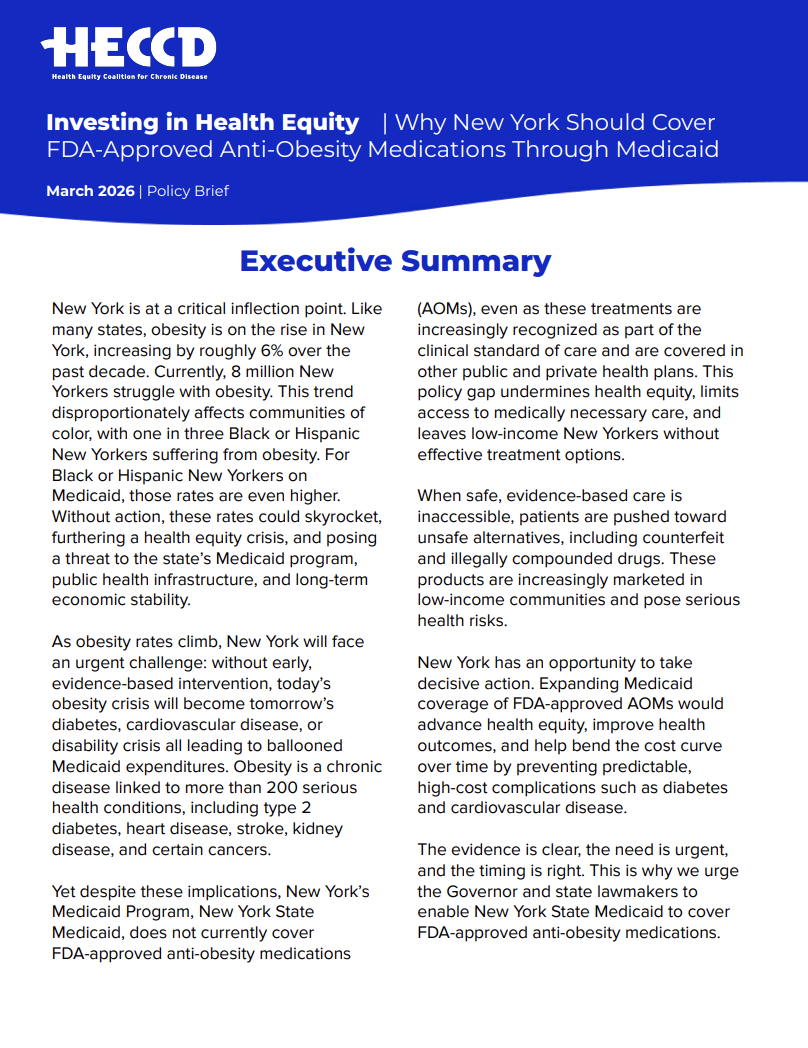
New York is at a critical inflection point. Like many states, obesity is on the rise in New York, increasing by roughly 6% over the past decade. Currently, 8 million New Yorkers struggle with obesity. This trend disproportionately affects communities of color, with one in three Black or Hispanic New Yorkers suffering from obesity. For Black or Hispanic New Yorkers on Medicaid, those rates are even higher. Without action, these rates could skyrocket, furthering a health equity crisis, and posing a threat to the state’s Medicaid program, public health infrastructure, and long-term economic stability.
As obesity rates climb, New York will face an urgent challenge: without early, evidence-based intervention, today’s obesity crisis will become tomorrow’s diabetes, cardiovascular disease, or disability crisis all leading to ballooned Medicaid expenditures. Obesity is a chronic disease linked to more than 200 serious health conditions, including type 2 diabetes, heart disease, stroke, kidney disease, and certain cancers.
Yet despite these implications, New York’s Medicaid Program, New York State Medicaid, does not currently cover FDA-approved anti-obesity medications (AOMs), even as these treatments are increasingly recognized as part of the clinical standard of care and are covered in other public and private health plans. This policy gap undermines health equity, limits access to medically necessary care, and leaves low-income New Yorkers without effective treatment options.
When safe, evidence-based care is inaccessible, patients are pushed toward unsafe alternatives, including counterfeit and illegally compounded drugs. These products are increasingly marketed in low-income communities and pose serious health risks.
New York has an opportunity to take decisive action. Expanding Medicaid coverage of FDA-approved AOMs would advance health equity, improve health outcomes, and help bend the cost curve over time by preventing predictable, high-cost complications such as diabetes and cardiovascular disease.
The evidence is clear, the need is urgent, and the timing is right. This is why we urge the Governor and state lawmakers to enable New York State Medicaid to cover FDA-approved anti-obesity medications.
Obesity Is a Health Equity Crisis
Obesity affects more than 42 percent of adults nationwide and is among the leading drivers of chronic disease in the United States, with profound implications for healthcare costs, workforce participation, and public programs such as Medicaid.[1] Yet despite its scale and impact, obesity is still too often framed as a matter of individual behavior rather than a chronic, multifactorial disease.
As the American Academy of Pediatrics observed in 2023, obesity has been “long stigmatized as a reversible consequence of personal choices,”[2] even though it is shaped by complex genetic, physiologic, socioeconomic, and environmental factors. This misunderstanding has real consequences for policy, particularly because the burden of obesity is not evenly distributed across the population.
Nationally, disparities are stark. Approximately 45.6 percent of Hispanic adults live with obesity, and nearly 79 percent of Hispanic women are overweight or obese, compared with 64 percent of non-Hispanic white women.[3] Black Americans are 28% more likely than U.S. adults overall to have obesity.[4]
These national trends are reflected in New York, where 35% of Black New Yorkers and 30% of Hispanic New Yorkers struggle with obesity.[5] These trends can also be compounded by other factors such as income and unequal access to:
- Affordable healthy food
- Safe outdoor and recreational spaces
- Reliable transportation
- Primary and preventive care
- Chronic disease management
- Culturally competent healthcare providers
Because Medicaid disproportionately serves low-income New Yorkers, communities of color, and people with chronic disease, obesity rates for Medicaid beneficiaries in New York are often higher than rates isolated by race or income level.[6] Thus, Medicaid is uniquely positioned to address health inequity. Without action, inequities will only continue to grow as private insurance coverage and direct to consumer purchasing expand.
Left unaddressed, this trajectory represents not only a threat to individual health outcomes and economic stability, but a growing risk to the sustainability of Medicaid and the broader healthcare safety net. Treating obesity as the chronic disease it is — as well as responding accordingly — is no longer optional; it is a fiscal and public health imperative. For New York, failing to act now does not save money, rather it defers costs until they are larger, harder to manage, and more inequitable.
The Cost of Inaction | Obesity as a Gateway to Medicaid Spending Growth
Obesity is not an isolated condition. It is a primary risk factor for type 2 diabetes, cardiovascular disease, and numerous other costly chronic illnesses. An estimated 60 to 90 percent of individuals with type 2 diabetes also live with obesity or have a history of obesity.[7]
This connection has direct fiscal consequences:
- Diabetes drives lifelong medication use, frequent hospitalizations, dialysis, amputations, and disability-related care.
- These downstream costs are predictable, recurring, and fall heavily on public payers — particularly programs like Medicaid and Medicare.
Evidence shows that treating obesity earlier can significantly reduce the incidence of type 2 diabetes by as much as 58 percent[8] and delay or prevent the onset of other high-cost complications. Yet despite the availability of effective treatments, obesity pharmacotherapy remains severely underutilized: fewer than 2 percent of eligible adults nationwide receive anti-obesity medications.[9] Failing to address prevention and treatment of obesity means we are giving up on the more than 100 million Americans who already live with this disease and continue to face social stigma.
Already, obesity places tremendous strain on the healthcare system and individuals in New York. Right now, obesity costs the New York State Medicaid Program an additional $868 million every year.[10] The financial impact doesn’t end there — for New York households, many of which are already struggling with an affordability crisis, obesity represents an additional $1.8 billion a year in increased medical expenses.[11] The cost implications are clear: as obesity severity increases, so do medical expenses, rising by nearly 70 percent for class 1 obesity, 120 percent for class 2, and more than 233 percent for class 3.[12]
Ensuring that all eligible Americans can access effective weight-loss therapies would not only improve health outcomes, but also deliver enormous economic value. Fewer obesity-related complications mean less disability, less pain, and nationally up to $100 billion annually in combined healthcare savings and quality-of-life gains.
AOMs Are Evidence-Based, Cost-Effective Care
FDA-approved anti-obesity medications are now widely recognized as part of the standard of care for chronic obesity management, particularly when combined with nutrition counseling and lifestyle interventions. It is unacceptable that many patients do not receive the standard of care needed for obesity, a chronic disease that requires a continuum of evidence-based interventions, beginning with nutritional counseling and structured physical activity and, when clinically appropriate, extending to metabolic surgery and FDA-approved anti-obesity medications.[13] Clinical evidence shows that these medications can:
- Produce sustained weight loss
- Improve quality of life
- Lower the risk of progression to type 2 diabetes
- Reduce cardiovascular risk
Cost concerns often reference official list prices that do not reflect the real, net cost. After rebates and concessions, the estimated net price for medications such as Wegovy is substantially lower — approximately $274 per month[14] — than official list prices. In addition, the federal government pays part of a state’s Medicaid costs through the Federal Medical Assistance Percentage (FMAP). The federal government’s FMAP payment to New York is around 50%,[15] meaning the federal government pays for approximately 50% of Medicaid services in the state. Additionally, recent commitments made by pharmaceutical companies to lower list prices may further improve the ability of states to budget for an expansion of care.
Importantly, Medicaid programs already use utilization management tools to manage access to specialty medications. Coverage of AOMs does not require abandoning these practices; it requires recognizing obesity as the chronic disease it is and the necessary tools that support long-term disease management — similar to how medications are used to manage hypertension, asthma, or high cholesterol.
Yet nationally, fewer than 2 percent of eligible adults receive anti-obesity medications.[16] This gap is driven largely by lack of coverage and affordability barriers. If Medicaid beneficiaries cannot access clinically appropriate obesity pharmacotherapy, the state risks reinforcing a two-tier system in which higher-income patients receive modern evidence-based care while low-income patients are left with limited options. When patients cannot access legitimate, FDA-approved treatments, many look for alternatives.
Across the country, counterfeit and illegally compounded GLP-1 drugs have proliferated, particularly through online vendors and informal markets. These products are not FDA-approved and are not subject to appropriate safety standards. The FDA has identified significant risks, including:
- Unknown or incorrect ingredients
- Unsafe dosing
- Contamination and improper storage
- Adverse events requiring medical care
- Fraudulent labeling and counterfeit packaging
These risks disproportionately affect low-income communities, where patients are more likely to face barriers to accessing safe and legitimate treatment through the healthcare system. Ensuring Medicaid beneficiaries have access to evidence-based obesity care is therefore not only a chronic disease strategy — it is also a public health safety strategy.
Why Action Is Needed Now
This moment calls for action. Without action, health disparities will only continue to rise in New York, magnifying long-term Medicaid exposure and making inaction increasingly costly. At the same time, there is broad clinical consensus that obesity is a chronic disease requiring comprehensive, evidence-based treatment, not episodic or incomplete care.
Leading health policy experts have reached the same conclusion. As the Institute for Clinical and Economic Review (ICER) recommended in 2022: “States should include coverage of weight loss medications under the auspices of the Medicaid program… Obesity is a growing health problem in the United States that has a particularly large impact on certain racial and ethnic groups… Considerable concern was [also] expressed by patient advocates and clinical experts that despite improvements in weight loss with existing medications and those undergoing clinical evaluation that current coverage policies and medication costs are likely to worsen disparities in accessing care unless specific action is taken.”[17]
Market dynamics further strengthen the case for action. Increased competition and emerging federal pricing signals are expected to continue placing downward pressure on the cost of anti-obesity medications, making expanded coverage more affordable now — and likely even more sustainable over time.
Against this backdrop, New York’s long standing leadership on health equity creates both an opportunity and a responsibility. Expanding Medicaid coverage for obesity treatment represents a logical extension of the state’s commitment to equitable, preventive care. Delaying action will only exacerbate existing disparities and drive higher long-term costs. Acting now offers the chance to improve health outcomes, protect vulnerable communities, and strengthen the long-term sustainability of New York State Medicaid.
Sources
[4] https://minorityhealth.hhs.gov/obesity-and-blackafrican-americans
[5] https://www.obesityaction.org/wp-content/uploads/New-York-1.pdf
[10] See 6
[11] See 6
The Health Equity Coalition for Chronic Disease (HECCD) is an advocacy coalition established to eliminate barriers to quality healthcare, particularly focusing on chronic disease by lifting the voices in communities of color and marginalized communities. HECCD is co-chaired by the Black Women’s Health Imperative, the National Hispanic Medical Association, and the National Minority Quality Forum. Beginning with a focus on policies that impact obesity, HECCD is committed to disease prevention and management and equitable health outcomes.