
March 2026 | Policy Brief
Executive Summary
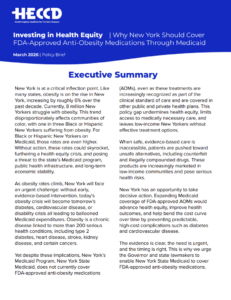
New Jersey is at a critical inflection point. Like many states, obesity is on the rise in New Jersey, increasing by roughly 6% over the past decade. Currently, 2 million New Jersey citizens struggle with obesity. This trend disproportionately affects communities of color, with roughly 30% of Black or Hispanic New Jerseyans suffering from obesity. For Black or Hispanic individuals on Medicaid, those rates are likely even higher. Without action, these rates could skyrocket, furthering a health equity crisis, and posing a threat to the state’s Medicaid program, public health infrastructure, and long-term economic stability.
As obesity rates climb, New Jersey will face an urgent challenge: without early, evidence-based intervention, today’s obesity crisis will become tomorrow’s diabetes, cardiovascular disease, or disability crisis all leading to ballooning Medicaid expenditures. Obesity is a chronic disease linked to more than 200 serious health conditions, including type 2 diabetes, heart disease, stroke, kidney disease, and certain cancers.
Yet despite these implications, New Jersey’s Medicaid Program, NJ FamilyCare, does not currently cover FDA-approved anti-obesity medications (AOMs), even as these treatments are increasingly recognized as part of the clinical standard of care and are covered in other public and private health plans. This policy gap undermines health equity, limits access to medically necessary care, and leaves low-income New Jerseyans without effective treatment options.
When safe, evidence-based care is inaccessible, patients are pushed toward unsafe alternatives, including counterfeit and illegally compounded drugs. These products are increasingly marketed in low-income communities and pose serious health risks.
New Jersey has an opportunity to take decisive action. Expanding Medicaid coverage of FDA-approved AOMs would advance health equity, improve health outcomes, and help bend the cost curve over time by preventing predictable, high-cost complications such as diabetes and cardiovascular disease.
The evidence is clear, the need is urgent, and the timing is right. This is why we urge the Governor and state lawmakers to enable NJ FamilyCare to cover FDA-approved anti-obesity medications.
Obesity Is a Health Equity Crisis
Obesity affects more than 42 percent of adults nationwide and is among the leading drivers of chronic disease in the United States, with profound implications for healthcare costs, workforce participation, and public programs such as Medicaid.[1] Yet despite its scale and impact, obesity is still too often framed as a matter of individual behavior rather than a chronic, multifactorial disease.
As the American Academy of Pediatrics observed in 2023, obesity has been “long stigmatized as a reversible consequence of personal choices,”[2] even though it is shaped by complex genetic, physiologic, socioeconomic, and environmental factors. This misunderstanding has real consequences for policy, particularly because the burden of obesity is not evenly distributed across the population.
Nationally, disparities are stark. Approximately 45.6 percent of Hispanic adults live with obesity, and nearly 79 percent of Hispanic women are overweight or obese, compared with 64 percent of non-Hispanic white women.[3] Black Americans are 28% more likely than U.S. adults overall to have obesity.[4]
These national trends are reflected in New Jersey, where 32% of Black and 28% of Hispanic individuals in New Jersey struggle with obesity.[5] These trends can also be compounded by other factors such as income and unequal access to:
- Affordable healthy food
- Safe outdoor and recreational spaces
- Reliable transportation
- Primary and preventive care
- Chronic disease management
- Culturally competent healthcare providers
Because Medicaid disproportionately serves low-income New Jerseyans, communities of color, and people with chronic disease, obesity rates for Medicaid beneficiaries in New Jersey are often higher than rates isolated by race or income level. Thus, Medicaid is uniquely positioned to address health inequity. Without action, inequities will only continue to grow as private insurance coverage and direct to consumer purchasing expand.
Left unaddressed, this trajectory represents not only a threat to individual health outcomes and economic stability, but a growing risk to the sustainability of Medicaid and the broader healthcare safety net. Treating obesity as the chronic disease it is is no longer optional; it is a fiscal and public health imperative. For New Jersey, failing to act now does not save money, rather it defers costs until they are larger, harder to manage, and more inequitable.
The Cost of Inaction | Obesity as a Gateway to Medicaid Spending Growth
Obesity is not an isolated condition — it is a gateway to some of the most expensive chronic diseases Medicaid covers. Left untreated, obesity drives up rates of type 2 diabetes, hypertension, heart disease, stroke, and certain cancers, all of which carry significant long-term treatment costs.[6] Nationally, obesity-related health spending totals hundreds of billions of dollars annually,[7] and Medicaid programs bear a disproportionate share of that burden because the populations they serve have higher obesity rates and less access to preventive care.
For New Jersey specifically, the math is unfavorable if the state continues to defer treatment. Every year without coverage for effective anti-obesity medications is a year in which more beneficiaries progress from obesity into costlier, harder-to-manage chronic conditions. A New Jersey op-ed on this exact issue put it plainly: the state’s current approach “asks patients to get sicker before the state will pay to help them get better.”[8]
This is the central fiscal irony of excluding AOMs from Medicaid coverage: it is framed as a cost-saving measure, but it is more accurately a cost-deferral measure. Refusing to pay for a medication now all but guarantees paying more for its downstream complications later — dialysis, cardiac procedures, amputations, and extended hospital stays are all costlier than a course of GLP-1 therapy.[9]
AOMs Are Evidence-Based, Cost-Effective Care
FDA-approved anti-obesity medications, including GLP-1 receptor agonists, have amassed a substantial evidence base demonstrating clinically meaningful weight loss alongside reductions in cardiovascular risk, improved glycemic control, and other measurable health benefits.[10] These are not lifestyle drugs; they are treatments for a diagnosed chronic disease, prescribed and monitored by physicians, with outcomes tracked in large randomized controlled trials.[11]
Multiple state Medicaid programs and private payers already cover these medications, recognizing that the upfront cost is offset over time by avoided complications.[12] Modeling on obesity-related disease trajectories consistently shows that early, evidence-based intervention costs less than managing the downstream chronic conditions obesity leaves untreated.[13]
When effective, physician-directed treatment is unavailable through Medicaid, patients do not simply forgo treatment — many seek it elsewhere, often through unsafe channels:
- Counterfeit versions of GLP-1 medications sold online with no quality assurance
- Illegally compounded formulations lacking FDA oversight
- Unregulated “weight loss clinics” marketing unproven or unsafe protocols
- Products purchased through unverified international pharmacies
These unsafe alternatives are increasingly marketed directly in low-income communities and communities of color — the same populations already carrying the highest obesity burden and the least access to safe, physician-supervised care.[14] Medicaid coverage of FDA-approved AOMs would close this gap and steer patients back toward safe, evidence-based treatment.
Why Action Is Needed Now
New Jersey has a narrow window to act before the costs of inaction compound further. Every year NJ FamilyCare excludes FDA-approved anti-obesity medications from coverage, more beneficiaries progress into the costlier chronic conditions obesity drives — diabetes, cardiovascular disease, and beyond — and more patients are pushed toward unsafe, unregulated alternatives.
We urge Governor Sherrill and New Jersey state lawmakers to enable NJ FamilyCare to cover FDA-approved anti-obesity medications. This is a health equity imperative, a patient safety imperative, and ultimately a fiscally responsible one: treating obesity as the chronic disease it is will cost New Jersey far less than continuing to pay for the diseases obesity leaves behind.
Sources
[4] https://minorityhealth.hhs.gov/obesity-and-blackafrican-americans
[5] https://www.obesityaction.org/wp-content/uploads/NewJersey2023.pdf
[9] https://www.northjersey.com/story/opinion/2026/02/06/nj-obesity-glp-1-opinion/88264205007/
The Health Equity Coalition for Chronic Disease (HECCD) advocates for equitable access to FDA-approved treatments for chronic disease, including obesity, across all communities.